Eisenhower and Montgomery at Fi156 in Italy
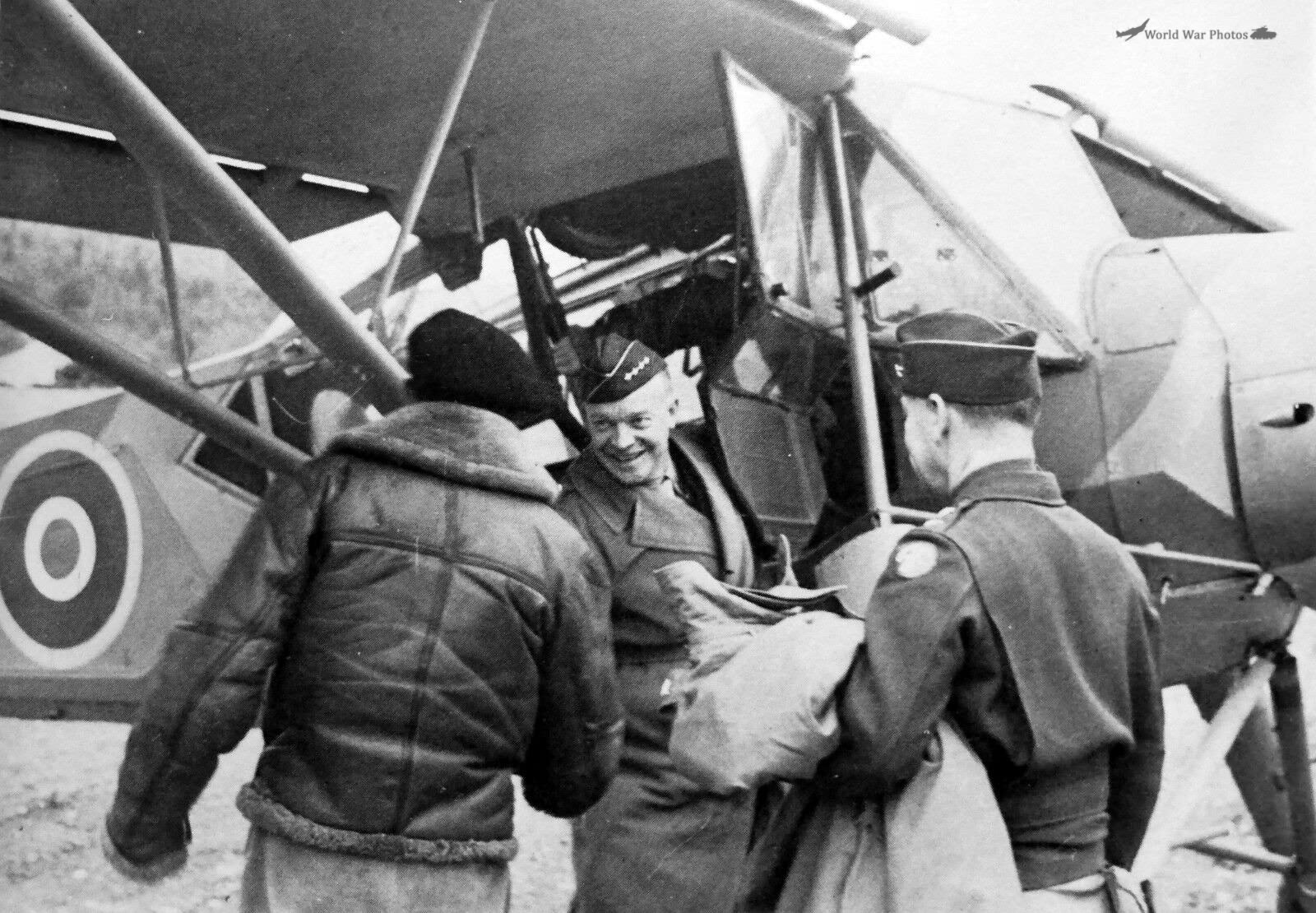
Eisenhower and Montgomery at Fi156 in Italy
The utilization of the Fieseler Fi 156 "Storch" by high-ranking Allied commanders, specifically General Dwight D. Eisenhower and Field Marshal Bernard Montgomery, underscores the aircraft's exceptional utility and the profound technical respect it commanded even among German adversaries. The aircraft’s short take-off and landing (STOL) capabilities made it a preferred "flying observation post" for theater commanders to conduct inspections of front-line positions.
General Dwight D. Eisenhower
The Supreme Allied Commander’s association with the Fi 156 began following the liberation of France. Historical records indicate that General Eisenhower received at least one Storch as a gift from French authorities. This specific airframe (likely Werknummer 85) was manufactured at the Morane-Saulnier factory in Puteaux, which had been liberated by Allied forces and continued production of the type.
In the autumn of 1944, Eisenhower utilized this aircraft for liaison duties in the Paris region. Technical illustrations and archival documentation confirm that the machine was finished in a standard camouflage scheme but modified with prominent United States Army Air Forces (USAAF) insignia, including the white star and bars, alongside the four stars indicative of his rank as a General.
Field Marshal Bernard Montgomery
Field Marshal Montgomery’s use of the Storch was extensive, spanning both the North African campaign and the post-war occupation of Germany. During his tenure as the commander of the British 8th Army in North Africa, Montgomery employed a captured Fi 156 C-5/Trop (formerly bearing the German registration KA+OS). This "war prize" allowed for rapid movement across the desert terrain where traditional landing strips were non-existent.
Operational Significance
For Allied leaders, the Storch represented a specialized asset that had no immediate contemporary equivalent in the Allied inventory in terms of its combination of low-speed stability and visibility. The aircraft served as a "status symbol" for army commanders, providing them with the necessary overview of the battlefield to make informed strategic decisions. Its reliability was such that it was also utilized for the inspection flights of other prominent figures, including Winston Churchill and General Alan Brooke.