Tupolev SB bomb bay
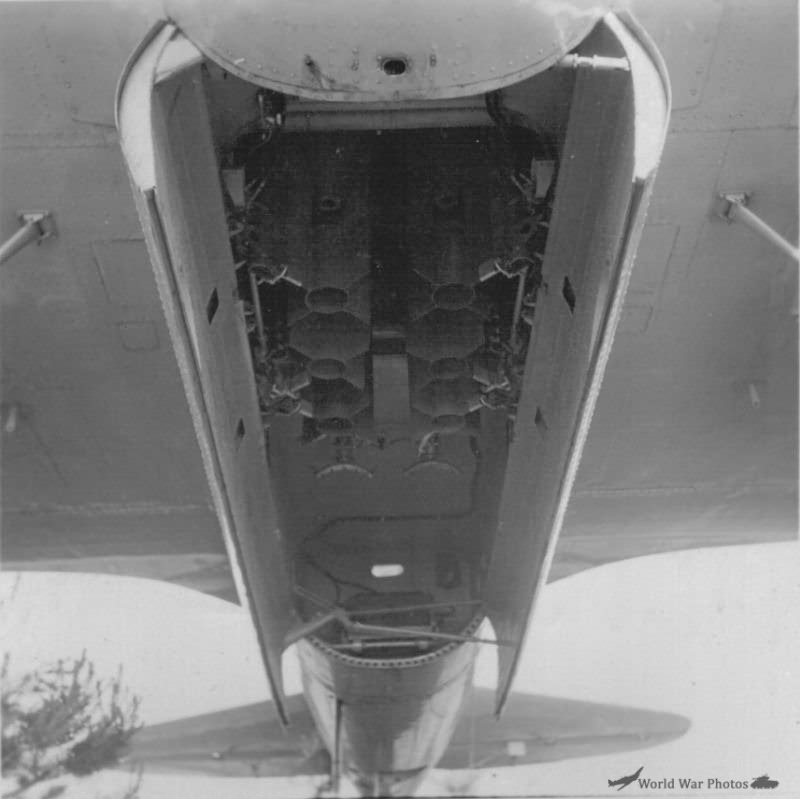
Tupolev SB bomb bay
The bomb bay was a central component of the aircraft's design, situated within the F-2 fuselage section directly beneath the pilot's cockpit.
Structural Configuration
The bomb bay was enclosed by a two-door hatch system located in the lower portion of the fuselage. These doors were secured by four hinges each and designed to open outwards. The opening mechanism for the doors was integrated into the front wall of the bay, which also accommodated various radio equipment and the piping for the aircraft's fuel jettison system. Operational control of the doors was accessible to both the pilot and the navigator/bombardier.
Ordnance and Internal Capacity
For the standard Tupolev SB-2 variants, the internal bomb bay was designed for a maximum load of 600 kg (1,323 lbs). This capacity was typically fulfilled by two primary rack configurations:
- Horizontal Carriage: Two DER-33 racks were used to carry either a single 500 kg (FAB-500) bomb or two 250 kg (FAB-250) bombs horizontally.
- Vertical Carriage: Four DER-34 racks allowed for the vertical stowing of up to six 100 kg (FAB-100) bombs. While vertical stowing allowed for more munitions, it was historically noted as being less accurate than horizontal carriage.
- Small Munitions: Starting from the 72nd series, six specialized bomb containers could be attached to the DER-34 racks, each holding thirty 2.5 kg bombs, for a total of 180 small projectiles.
Loading and Release Systems
To facilitate the loading of heavy ordnance, the aircraft utilized BL-3 mechanical winches. These were typically mounted either on the main landing gear forks or in specialized access holes atop the fuselage behind the pilot’s cockpit. Once loaded, the bombs were secured with locks and side braces to prevent rocking during flight.
The release of ordnance was managed through an ESBR-3 electrical bomb release system, with an ASBR-3 mechanical backup provided for emergencies or malfunctions. In earlier models, release levers were located in the navigator's compartment, but from the 96th series onward, these controls were duplicated in the pilot's cockpit for improved reliability.
Non-Combat Modifications
In the civilian transport variants, such as the PS-40 and PS-41, all internal bomb racks and combat equipment were removed. The former bomb bay was repurposed as one of three cargo compartments, which, when combined with the nose and rear gunner's sections, provided a total cargo volume of 2.6 m³.