Tupolev SB with ski undercarriage, Winter 1940
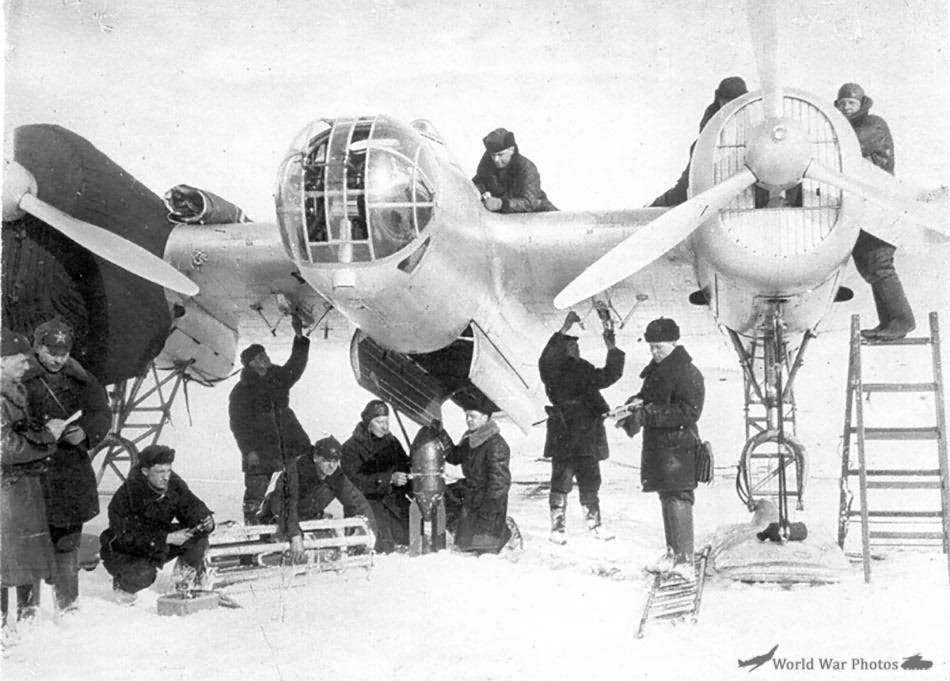
Tupolev SB 1940
The implementation of ski undercarriages on the Tupolev SB series was a critical adaptation to the harsh operational realities of the Soviet climate, though it imposed severe penalties on the aircraft's aerodynamic efficiency and combat survivability. The transition to winter gear was a logistical necessity dictated by the fact that standard wheeled landing gear became unserviceable when snow depths exceeded 30 to 70 centimeters.
Impact on Airspeed and Aerodynamic Drag
The most immediate and detrimental effect of ski gear on flight performance was the drastic increase in aerodynamic drag. Early iterations of the SB, including prototypes like the ANT-40IS, utilized non-retractable (fixed) ski assemblies. These fixed units acted as significant "drag anchors," limiting the maximum airspeed of the Hispano-Suiza-powered prototype to just 351 km/h (218 mph) at 4,000 meters - a marked reduction from its theoretical potential.
In operational contexts, particularly during the Soviet-Finnish Winter War (1939–1940), standard SB units equipped with non-retractable skis suffered from a flight speed reduction to approximately 300 km/h (185 mph). This loss of speed was catastrophic from a tactical standpoint, as it stripped the SB of its primary defense - its ability to outrun enemy interceptors - and rendered it "easy prey" for even obsolescent Finnish fighter types. Even on more advanced, aerodynamically refined versions like the SB-2 M100-A (Modified), the inclusion of skis resulted in a speed loss of roughly 11 km/h (6.8 mph) compared to standard wheeled production models.
Development of Retractable Ski Gear
Recognizing that fixed skis compromised the high-speed profile of the aircraft, Soviet engineers developed retractable ski gear, first tested on the ANT-40-2 prototype as early as 1936. These units were designed to fold into the engine nacelles, much like the standard wheels, to restore aerodynamic cleanliness during flight. To further minimize drag when the gear was stowed, a specialized recessed fairing was mounted underneath the nacelle. By 1940, series production models such as the SB-2-M-105 and the Arkhangelskiy Ar-2 were equipped with these systems, which allowed the aircraft to maintain higher cruise and combat speeds while operating from snow-bound airfields.
Takeoff and Landing Characteristics
While skis hindered maximum velocity, they offered specific advantages regarding takeoff performance on snow-covered surfaces. For the late-series SB-2-M-105, the takeoff run on ski gear was recorded at approximately 215 meters, a significant improvement over the 295-meter run required for wheeled gear on similar terrain. However, the use of skis necessitated changes in piloting technique; test reports for the Ar-2 noted that takeoff and landing speeds slightly increased when using winter gear. Furthermore, the ski gear was physically demanding on the airframe; early wooden ski surfaces were notoriously fragile, often becoming fully unserviceable after only 30 to 40 landings.
Summary of Performance Trade-offs
In conclusion, while the ski undercarriage was an indispensable tool that provided the VVS (Soviet Air Force) with a unique level of winter mobility, it came at the cost of the SB's defining characteristic: its speed. The drag induced by even the best-designed ski gear altered the aircraft’s stability and responsiveness, forcing crews to operate at lower altitudes and slower speeds that increased their vulnerability to anti-aircraft fire and enemy fighters.