XP-38K 41-1983
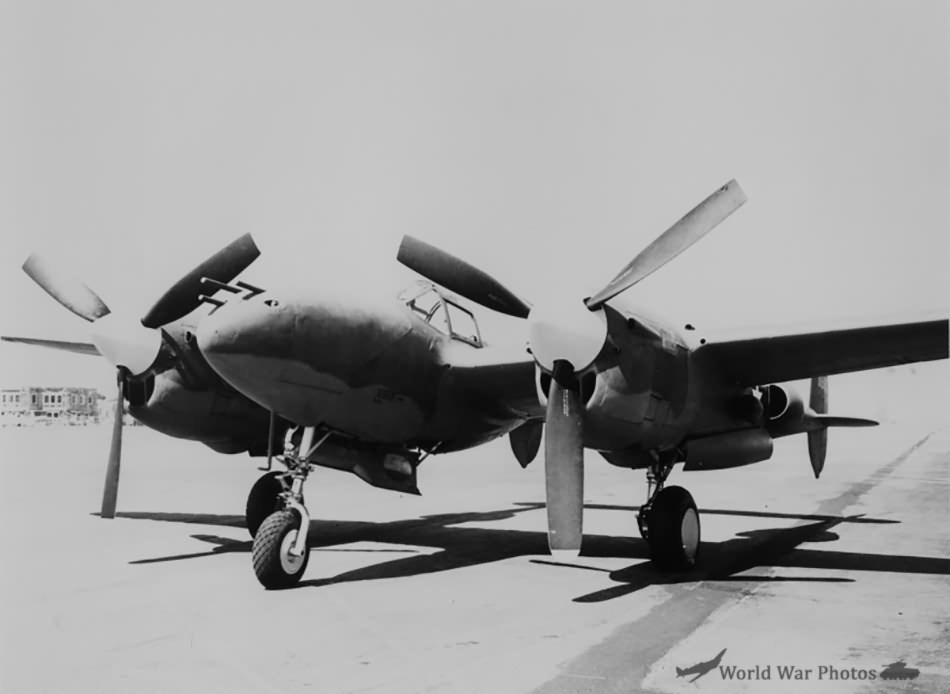
XP-38K 41-1983
The Lockheed XP-38K, often referred to in developmental documentation as the "K-Mule," represented a significant evolutionary attempt to maximize the high-altitude capabilities of the Lightning series. Historically, this project involved two distinct airframes: a hybrid experimental testbed converted from a well-used RP-38E (serial number 41-1983) and a second, more refined prototype designated P-38K-1-LO (serial number 42-13558) converted from a P-38G-10-LO.
Technical Configuration and Propulsion
The defining characteristic of the XP-38K was its propulsion system, which utilized a pair of Allison V-1710-75/77 (F15 series) engines. These powerplants were uniquely paired with broad-chord, paddle-bladed Hamilton Standard Hydromatic propellers designed for high-activity performance at extreme altitudes. Because the engines were intended to operate with these specialized propellers, the reduction gear ratio was adjusted to 2.36:1, compared to the 2.00:1 ratio used on the standard P-38J.
To accommodate the larger diameter of the propeller spinners and the associated engine components, the cowlings required significant modification. This resulted in a hand-made cowling line that was approximately one inch higher than that of standard production models. Furthermore, the XP-38K served as a developmental testbed for the core-type intercoolers and deep "chin" radiators that eventually became the primary external recognition features of the subsequent P-38J and L variants.
Performance Metrics
Flight testing conducted between February and April 1943 demonstrated that the XP-38K was arguably the most capable Lightning variant ever produced in terms of speed and climb.
- Altitude and Climb: The aircraft reached an altitude of 45,000 feet with relative ease during trials, and Lockheed engineers estimated that it would have a service ceiling well above 46,000 feet in standard atmospheric conditions. It demonstrated an initial rate of climb of 4,800 feet per minute and could reach 20,000 feet in exactly five minutes.
- Level Speed: At its critical altitude of 29,600 feet, the aircraft achieved a maximum speed of 432 mph, which was 14 mph faster than a contemporary P-38J-1-LO.
- High-Altitude Advantage: The performance gap became even more pronounced at extreme altitudes; at 40,000 feet, the XP-38K was noted to be 40 mph faster than the standard J-model.
Cancellation and Production Hiatus
Despite the aircraft's clear superiority to all other production fighters of the era, the USAAF and the War Production Board (WPB) ultimately declined to order the type into mass production. The primary deterrent was the logistical disruption that would be caused by a transition to the K-model. Because of the one-inch height difference in the engine cowlings and the different propeller requirements, it was estimated that retooling the Burbank assembly lines would cause a production hiatus of two to three weeks.
During the critical period of late 1943, when front-line demand for Lightnings was at its peak, such a delay was deemed strategically unacceptable. Additionally, there were concerns that the F15 version of the Allison engine could not be produced in sufficient quantities to satisfy the requirements of a mass-production contract. Consequently, the P-38K program was abandoned in favor of the continued production of the P-38J and the subsequent P-38L. The lone purpose-built P-38K-1-LO prototype was never photographed in its final state due to wartime security and was eventually retired from testing.