Focke-Wulf Ta 154 V7 TE+FK 2
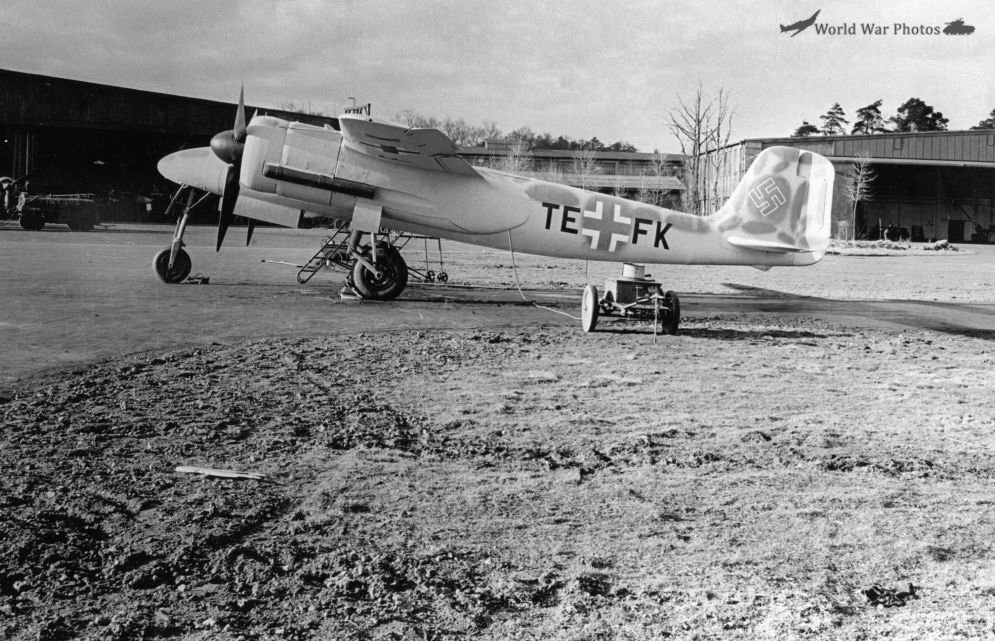
Ta 154 V7 TE+FK 1944
The Focke-Wulf Ta 154 V7 (Werknummer 0007, later redesignated as 100 007) carried the radio call sign TE+FK. It served as a critical pre-production prototype intended for operational testing and was one of the first machines assigned to Erprobungskommando (E.Kdo) 154.
Development and Maiden Flight
The V7 made its first flight on March 25, 1944, shortly after the V6. From the V6 and V7 onwards, a standardized set of basic equipment was established for subsequent prototypes, which included:
- Powerplant: Two Junkers Jumo 211 N engines driving VS 11 airscrews.
- Armament: Four 20 mm MG 151/20 cannon.
- Construction: A wooden front section, a hinged canopy, and the inclusion of Rückenfallschirm (Rufa – back parachutes) for the crew.
- Undercarriage: Electric hydraulics and a compressed air nosewheel with a large castor.
- Special Features: Unlike some earlier prototypes, the V7 was equipped with flame-dampers from the outset to facilitate night operations. Interestingly, while it carried full night-fighter internal equipment, it lacked external radar antennas.
Operational Testing and Performance Issues
The V7 was delivered directly to E.Kdo 154 for evaluation. During testing, the Kommando reported several flight characteristic issues that required adjustment:
- Stability: At its rearmost center of gravity, the aircraft showed little stability around the transverse axis, leading to suggestions that the horizontal stabilizer should be enlarged.
- Control Forces: The aileron forces were reported as much too high, and there were difficulties with the non-analogous height trim indicator and radiator flap adjustments.
- Durability: In bad weather, the paint on the wing leading edges and tips - which was not the specialized Aviatin paint - would peel, causing the wood to fray at the edges.
- Safety: The raised back armor and equipment container were noted as posing a potential danger to the pilot during an emergency exit.
Operational History and Destruction
The V7’s testing career was interrupted on April 8 (or 9), 1944, when it was damaged by enemy action. The resulting repairs were extensive, requiring a planned four-week period to return the machine to flight status. By October 1944, it was assigned to trials for electronics and intended for training Ta 154 crews.
The aircraft met its end on August 5, 1944, during a heavy Allied air attack on Langenhagen. The V7 suffered 70% damage in the raid and was eventually destroyed along with most of the other prototypes on the field.