Focke-Wulf Ta 154 V3 TE+FG
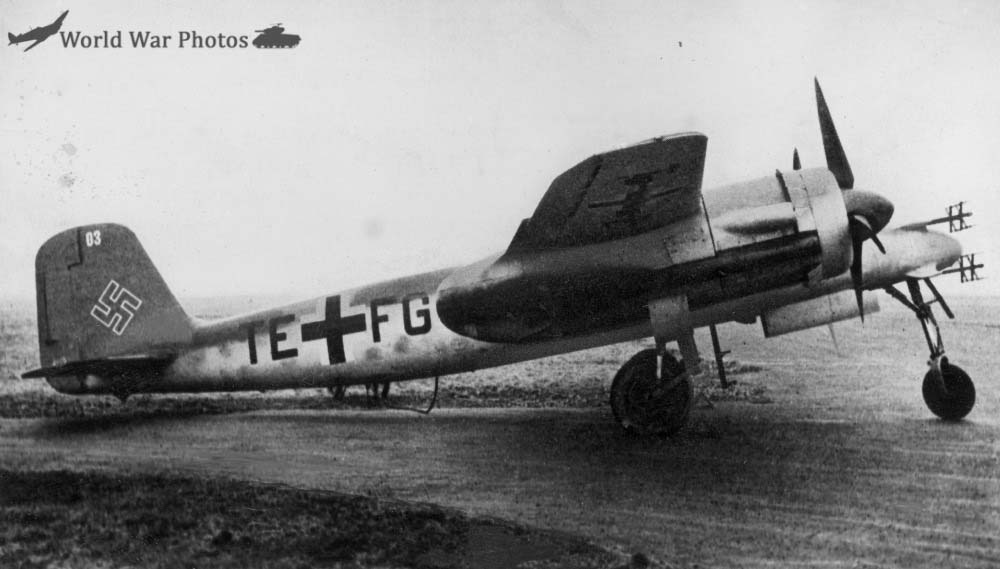
Ta 154 V3 TE-FG
The Focke-Wulf Ta 154 V3, designated with the factory serial number Werknummer 100 003 (originally 0 003) and the radio call sign (Stammkennzeichen) TE+FG, represented a critical milestone in the "wooden wonder" program as the first prototype to be delivered as a fully equipped experimental night fighter.
Maiden Flight and Initial Testing
The V3 took to the skies for the first time on November 25, 1943, piloted by factory pilot Werner Bartsch at Langenhagen. Unlike the preceding performance prototypes, the V3 was "packed" with operational equipment, including the first installation of a fixed armament of four 20 mm MG 151/20 cannon. It also featured a comprehensive radio and radar suite, initially comprising the FuG 212 Lichtenstein C-1 radar, FuG 101, FuG 16 ZE, and FuG 25a.
Demonstration to German Leadership
Immediately following its completion, the V3 was selected for a high-profile demonstration. On November 26, 1943, Bartsch flew the aircraft to Insterburg in East Prussia for the "Hitler-Vorführung" (Hitler presentation), where it was displayed alongside other advanced German aircraft for Adolf Hitler and Reichsmarschall Hermann Göring. Bartsch performed a 50-minute demonstration flight on November 30 before returning the machine to Langenhagen via Lüneburg.
Equipment and Performance Upgrades
While the V3 was initially powered by Junkers Jumo 211 F engines, it served as a primary testbed for evolving night-fighting technology. On December 21, 1943, the aircraft was retrofitted with the more advanced FuG 220 Lichtenstein SN-2 radar, characterized by its large "antler" dipole antennas.
In performance trials with full equipment and a weight of 8,400 kg, the V3 achieved:
- Top Speed: 574 km/h at an altitude of 6,400 meters.
- Service Ceiling: 9,900 meters.
Operational evaluation was conducted by experienced night fighter pilots, including Major Wilhelm Herget and Hauptmann Ludwig Meister of NJG 4. While they were satisfied with the aircraft’s maneuverability and acceleration, they were highly critical of the poor visibility to the rear and sides caused by the narrow cockpit and engine nacelles.
The Sorau Accident
The V3's flight testing career was cut short by a catastrophic landing accident on February 28, 1944, at Sorau. During a landing on an ice-encrusted runway, the nosewheel turned sideways and collapsed. This failure was later attributed to an insufficient castor (only 9% on early models), which made the nosewheel unstable under certain conditions. The resulting impact destroyed the wooden forward fuselage; the pilot, Konrad Carl, suffered minor injuries, while the second seat was fortunately unoccupied.
Final Destruction and Legacy
Although repairs were considered possible by replacing the forward section, the V3 remained at Langenhagen where it was eventually completely destroyed during a massive Allied air attack on August 5, 1944.