Fi 156 Storch WL+IJY Radom, Poland
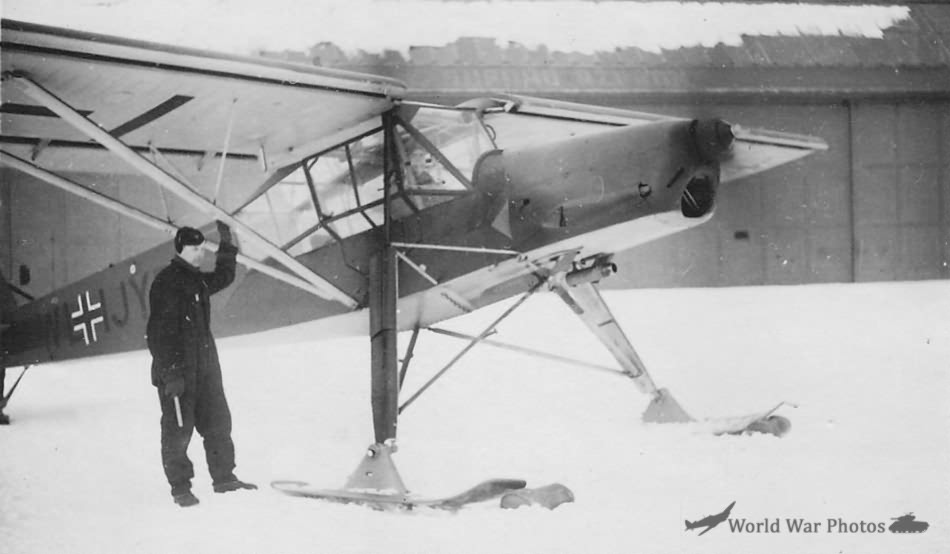
Fi 156 Storch WL+IJY with ski undercarriage
The implementation of a ski undercarriage (Schneekufen) was a critical technical adaptation for the Fieseler Fi 156, enabling the aircraft to maintain its short take-off and landing (STOL) capabilities in extreme winter environments and arctic conditions. This modification replaced the standard wheels with specialized skis to prevent the aircraft from sinking into deep snow and to allow operations from frozen bodies of water.
The technical development and operational history of the ski undercarriage are characterized by the following details:
- Early Development and Testing: The use of skis was explored early in the Storch's history. The second prototype, Fi 156 V2 (D-IGLI), was equipped and tested with skis as early as the winter of 1936/37 in the Zugspitzmassiv. Subsequently, the Fi 156 V4 (D-IFMR) was specifically prepared with a ski undercarriage for a 1938 expedition to the North Pole and Spitzbergen, proving the design's effectiveness in harsh polar climates.
- Mechanical Configuration: The standard ski installation involved replacing the two main wheels with large, flat skis. A corresponding smaller ski was also fitted to the tail, replacing the traditional tail skid or wheel to ensure the entire airframe remained elevated above the snow surface. In the Luftwaffe’s classification system, the ski undercarriage was designated as Rüstsatz 3.
- Flight Stabilization: A notable engineering challenge involved maintaining the correct orientation of the skis during flight. To address this, a spring-loaded mechanism (Federmechanismus) was incorporated into the undercarriage legs. This system ensured that the skis remained in a horizontal position while airborne, preventing them from catching the wind or rotating into a dangerous angle that could cause a crash upon landing.
- Operational Necessity: On the Eastern Front and in Scandinavia, the ski gear became an indispensable requirement during winter months. In environments such as Norway in early 1945, the terrain frequently made the use of skis mandatory for all liaison and cable-laying missions. The skis allowed the Storch to function as a "flying ambulance" or supply plane in regions where traditional runways were buried under meters of snow or where landing on frozen lakes was the only option.
- Combined Gear Experiments: Some experimental versions, such as the Fi 156 C-1, were tested with a "combined undercarriage" (kombiniertem Fahrwerk), which attempted to integrate both wheels and skis, though the standard interchangeable configuration remained the most common in front-line service.
The ski undercarriage fundamentally extended the operational envelope of the Fi 156, allowing it to remain the primary utility and observation platform for the German military regardless of seasonal weather extremes.