Prototype Lockheed XP-38 7
XP-38 7
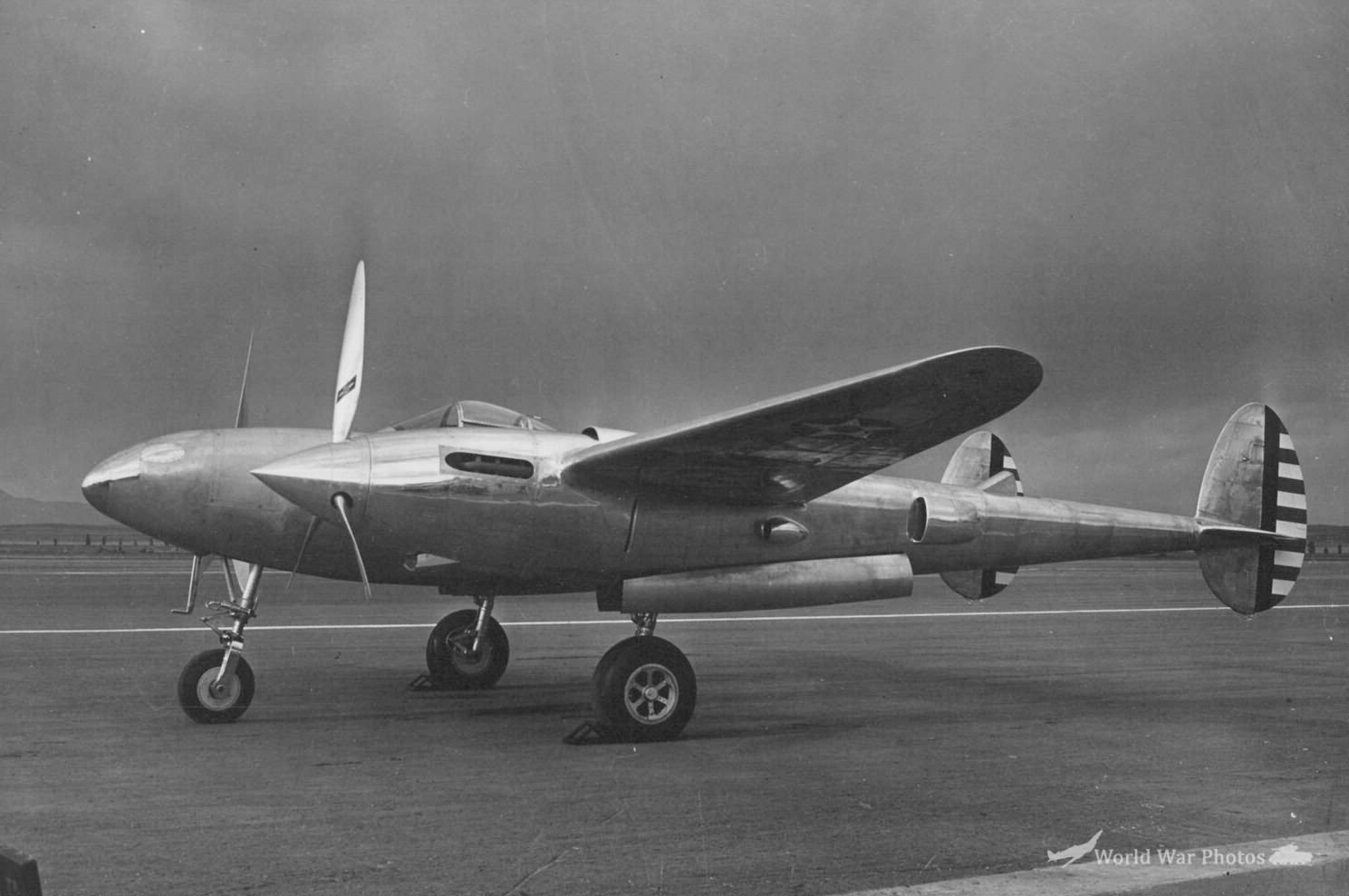
The Lockheed XP-38, bearing the military serial number 37-457 and manufacturer designation Model 022-64-01, was the foundational prototype of the Lightning series, designed to meet the rigorous requirements of U.S. Army Air Corps (USAAC) Specification X-608. This specification called for a twin-engine interceptor capable of reaching 360 mph at 20,000 feet and climbing to that altitude within six minutes, goals which the Lockheed design team, led by Hall Hibbard and Clarence "Kelly" Johnson, ultimately exceeded. Construction began in July 1938 in a high-security area of the Burbank factory, where the aircraft was meticulously built almost entirely by hand.
The airframe was a radical departure from contemporary pursuit designs, featuring two long, slim booms that housed the engines, turbosuperchargers, and landing gear, while the pilot and armament were concentrated in a central nacelle. It was the first American aircraft to utilize a completely flush-riveted, butt-jointed aluminum skin and was also the first fighter equipped with a fully retractable tricycle landing gear. To address the intense heat generated by the General Electric turbosuperchargers, company engineers pioneered the use of stainless steel in significant portions of the tail booms.
The XP-38 was powered by two Allison V-1710-11 and -15 (C-series) liquid-cooled engines, which were rated at 1,150 horsepower for takeoff. A defining characteristic of the XP-38 was the direction of its propeller rotation; the Curtiss Electric three-bladed propellers counter-rotated inwards at the top, a configuration that was later reversed to outward rotation in all subsequent P-38 variants to improve longitudinal stability and reduce tail buffeting. Physically, the prototype was distinguished by a rounded, frameless one-piece windshield, retractable oil cooler scoops under the nacelles, and a horizontal stabilizer that was shorter in span than production models.
Although the XP-38 featured nose-mounted tubes for a planned armament of one 23mm Madsen cannon and four .50-caliber machine guns, no weapons were ever actually installed in the prototype. The aircraft was finished in a highly polished natural aluminum, giving it the sleek appearance of a racing machine rather than a standard warplane. Performance trials indicated a maximum speed of 413 mph at 20,000 feet, which at the time made it the fastest non-racing airplane in the world.
The flight testing program was overseen by Lieutenant Benjamin S. Kelsey, who conducted the first flight on January 27, 1939, from March Field. This maiden flight lasted thirty-four minutes and was nearly cut short by severe vibrations caused by the failure of three aluminum flap support rods, though Kelsey managed a safe landing. Following repairs and modifications to the flap mechanism and the braking system, the aircraft completed several additional test flights totaling approximately eleven hours of air time.
The XP-38’s career ended abruptly on February 11, 1939, during a high-profile transcontinental record flight from California to New York. After refueling stops at Amarillo, Texas, and Wright Field, Ohio, Kelsey reached the vicinity of Mitchel Field on Long Island in a record flying time of seven hours and two minutes. During the final approach, while trailing several slower-moving aircraft, the engines suffered a power loss - historically attributed to carburetor icing - causing the aircraft to crash on the Cold Stream Golf Course. While Kelsey survived the incident unhurt, the XP-38 was declared a total loss and was subsequently scrapped. Despite its destruction, the prototype's demonstrated performance successfully convinced the USAAC to move forward with the program, leading to an immediate order for thirteen YP-38 service test aircraft.