
F4F Wildcat part 1
Click the thumbnails to enlarge them
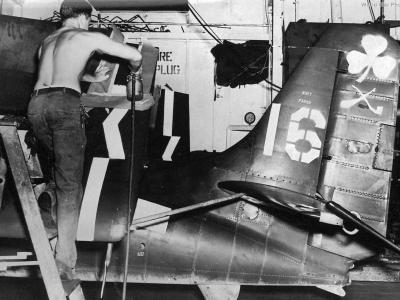
A sailor applies markings to a FM-2 Wildcat of VC-94 USS Shamrock Bay CVE-84

Aircraft Carrier Crash Crew Rescues F4F Wildcat after bad landing
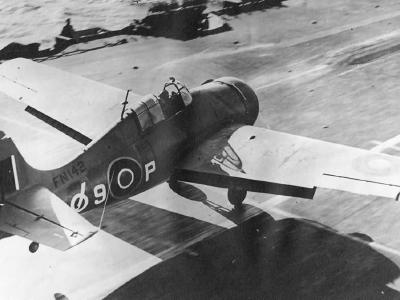
British F4F Martlet Mk IV FN142
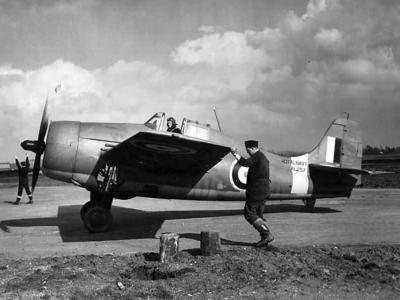
British Martlet Mk I AL257

British Martlet Mk I AL257 of No. 804 Squadron
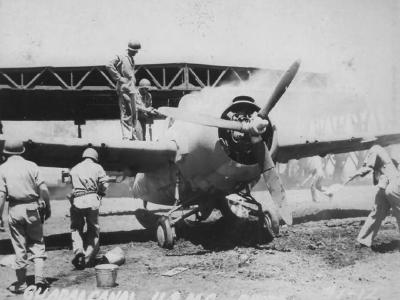
Burning Marine F4F-4 Henderson Field Guadalcanal

Cactus Air Force F4F Wildcats on Fighter 1 Airstrip Guadalcanal 1943
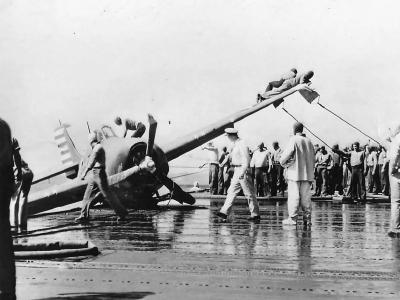
Crew aboard Aircraft Carrier Work to Right Crashed Wildcat 1942
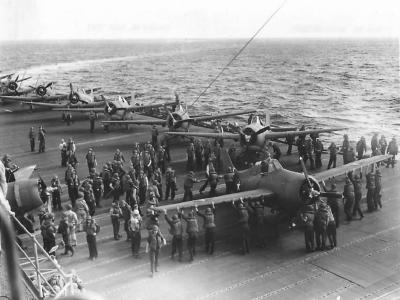
Deck crew pushing a returning F4F into position on the deck of an aircraft carrier 1942
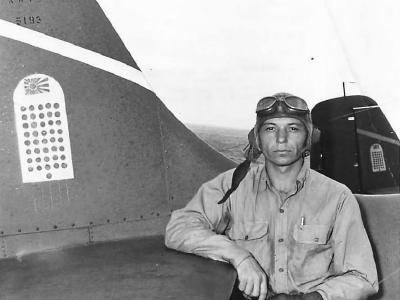
Donald Runyon standing by the tail of his F4F-4 5193 #13 September 1942, VF-6 USS Enterprise
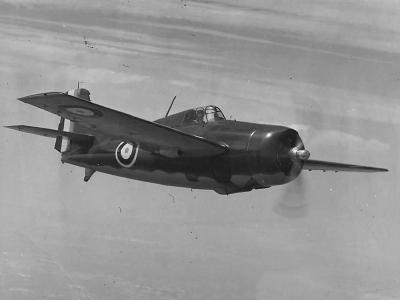
ex-French Martlet I Grumman G-36A, July 1940
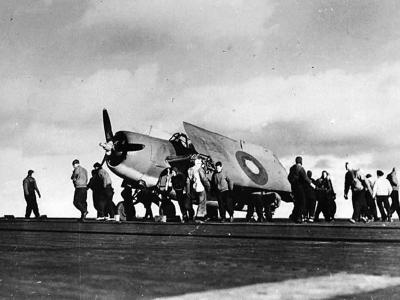
F4F Martlet on the flight deck
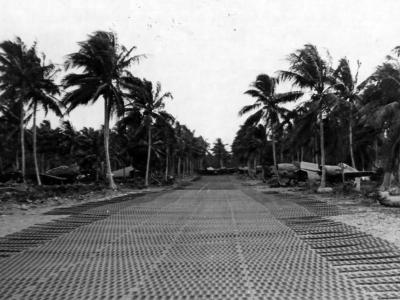
F4F NEW HEBRIDES 1943
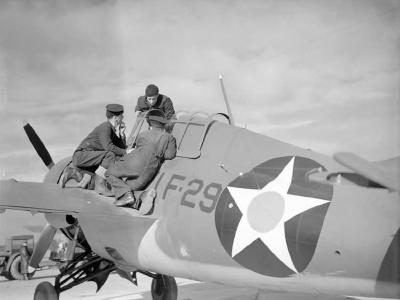
F4F of VF-41, April 1942 Royal Naval Air Station Hatston

F4F of VF-8 USS Hornet Battle of Midway

F4F USMC Ace Joe Foss and Crew Loads Ammo on His Plane
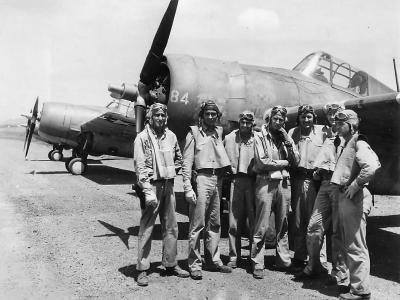
F4F VMF-121 Ace Joe Foss and Joe's Flying Circus Pilots on Guadalcanal 1943

F4F Wildcat and Marine Aces Smith (MoH VMF-223) Fraizer, Dobbin and Galer (MoH) at Guadalcanal 1942

F4F Wildcat code F20 USS Enterprise CV-6 Task Force 16 - 16 April 1942
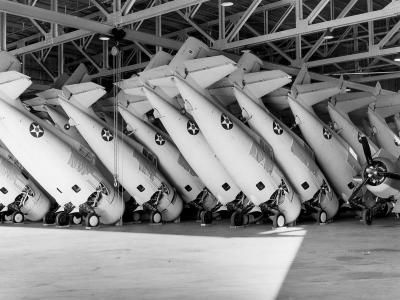
F4F Wildcat fuselages in Grumman Plant Tat Bethpage Long Island New York

F4F Wildcat Grumman test pilot Corwin Meyer demonstrating the deployment of the pilots life raft 19 November 1942
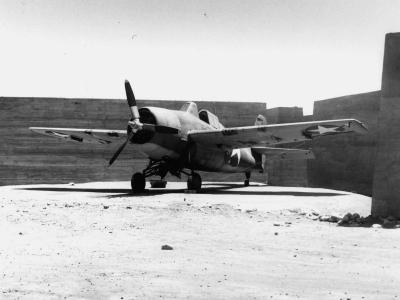
F4F Wildcat of VMF-121 at Camp Kearny California Summer 1942
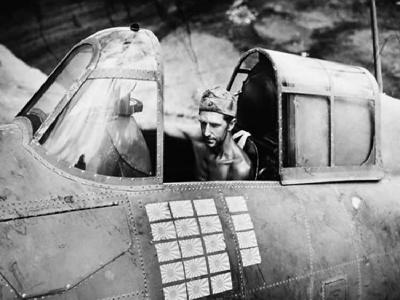
F4F Wildcat Sgt. R.W.Greenwood in cockpit Henderson Field Guadalcanal
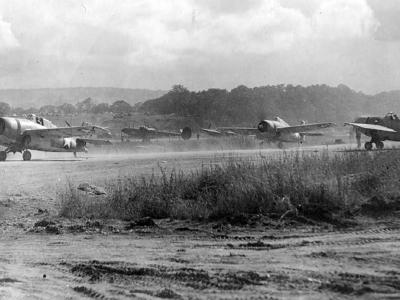
F4F Wildcats of VF-11 Sundowners on Guadalcanal
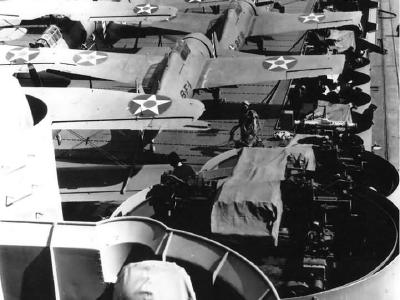
F4F Wildcats of VF-8 USS Hornet 1942
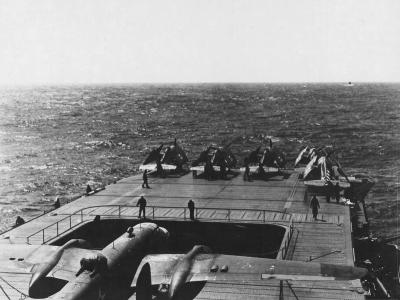
F4F Wildcats on flight deck of USS Hornet 18 April 1942
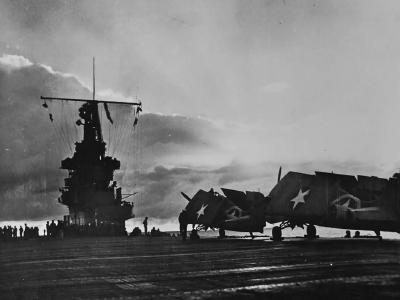
F4F Wildcats Operation Torch 1942
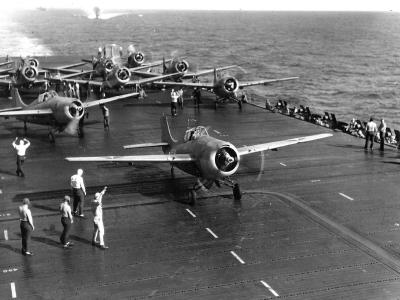
F4F-3 of VF-6 leads a pack of aircraft readying for launch from the carrier USS Enterprise in May 1942
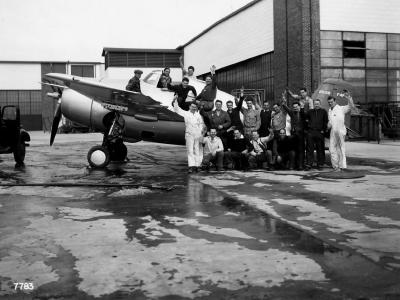
F4F-3 Wildcat Bethpage Long Island plant, February 21 1941
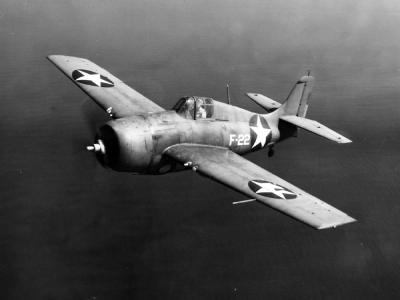
F4F-3 Wildcat code F-22
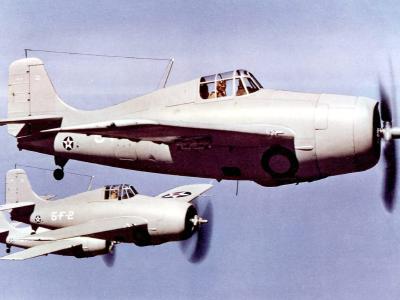
F4F-3 Wildcats of VF-5 USS Yorktown 1941 (color photo)

F4F-3A Wildcats of VF-3: F-1 pilot LCdr John Thach and F-13 pilot Lt Edward O'Hare April 1942
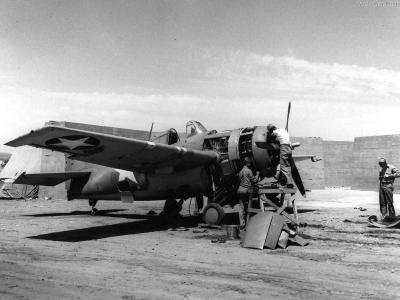
F4F-4 of the VMF-121 undergoing maintenance at Camp Kearny California 1942

F4F-4 Wildcat of VF-6 flight deck of the carrier Enterprise CV-6, 10 April 1942

F4F-4 Wildcat of VMF-441 taxis at the airfield on Nanumea in the Ellice Islands in September 1943

F4F-4 Wildcats of the VF-9 USS Ranger (CV-4) Operation Torch
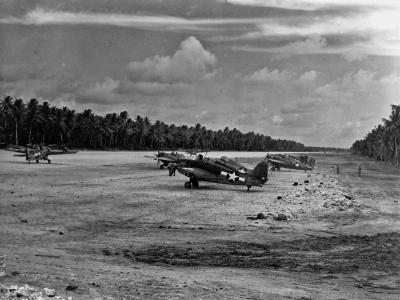
F4F-4 Wildcats of VMF-441 at Nanumea Ellice Island, October 23 1943

F4F-4 Wildcats of VMF-441 at the airfield on Nanumea in the Ellice Islands in September 1943

F4F-4 Wildcats packed on the hangar deck of the USS Charger AVG-30 - 2 October 1942
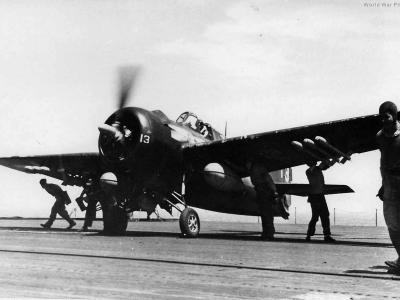
Flight deck crewmen conduct final checks on an FM before it launches from USS Anzio (CVE-57) for close air support mission over Okinawa in April 1945
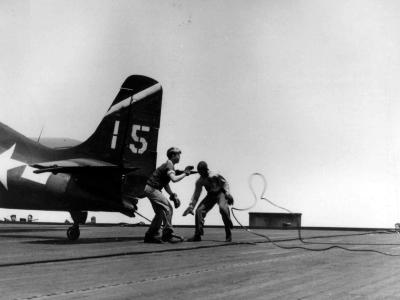
Flight deck crewmen remove the arresting wire from the tailhook of an FM-2 from VC-82 USS Anzio (CVE-57) in 1944
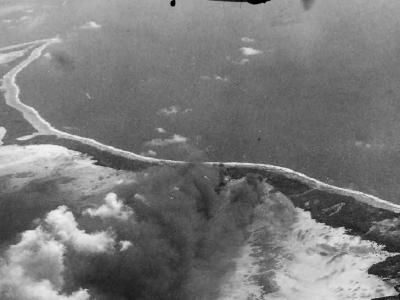
FM-1 Wildcat flown by Lt (jg) Knudson of VC-41 USS Corregidor CVE-58 over Makin Atoll, 20 November 1943

FM-1 Wildcat of VC-12 launching from the escort carrier USS Kasaan Bay CVE-69 - 6 February 1944

FM-1 Wildcats and TBM-1 Avengers from VC-42 during loading on board USS Guadalcanal CVE-60 at NAS San Diego, 31 October 1943

FM-2 Smokeys Lucky Witch Ensign Darrell Bennett USS Gambier Bay (CVE-73)
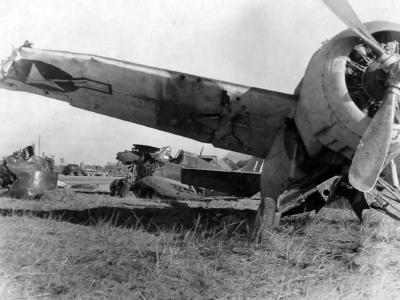
FM-2 Tacloban October 1944

FM-2 Wildcat 1 of VC-79 on board USS Sargent Bay CVE-83 Okinawa on 2 April 1945

FM-2 Wildcat 2 of VC-84 on the flight deck of the escort carrier USS Makin Island CVE-93 invasion of Luzon in the Philippines, 8 January 1945

FM-2 Wildcat A16 of VC-78 on board the escort carrier USS Matanikau CVE-101, 16 November 16 1944

FM-2 Wildcat code '20' of VC-71 on board the escort carrier USS Hoggatt Bay CVE-75 July 1945
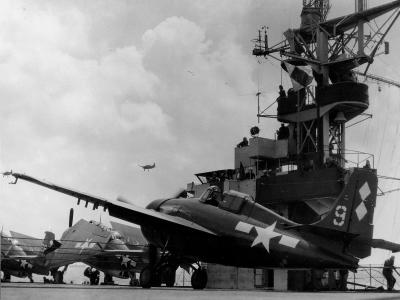
FM-2 Wildcat code '9' of VC-79 after catching a wire on board the escort carrier USS Sargent Bay CVE-83 - Okinawa 25 March 1945

FM-2 Wildcat code C28 of VC-11 slams into the barricade escort carrier USS Nehenta Bay CVE-74 on 21 January 1945

FM-2 Wildcat code D12 of VC-79 on the the flight deck of the escort carrier USS Sargent Bay CVE-83 - 11 January 1945

FM-2 Wildcat D1 of VC-79 after engaging the barricade on board carrier USS Sargent Bay CVE-83 - 7 February 1945

FM-2 Wildcat D6 Judy of VC-14 on the flight deck of the escort carrier USS Hoggatt Bay CVE-75 Philippines 22 November 1944

FM-2 Wildcat of VC-70 attempting to trap on the flight deck of the escort carrier USS Salamaua CVE-96 - 7 September 1945

FM-2 Wildcats of VC-79 on board the escort carrier USS Sargent Bay CVE-83 invasion of Iwo Jima 19 February 1945
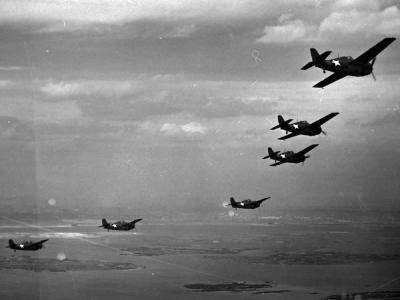
Formation of F4F-4 Wildcats of VF-24 in flight NAS Floyd Bennett Field New York - 28 April 1943

Formation of Grumman F4F Martlets of No. 804 squadron Fleet Air Arm 1940, Scapa Flow
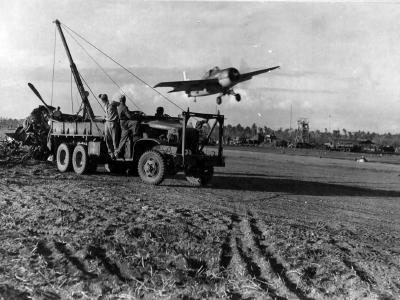
General Motors FM-2 Tacloban Leyte

General Motors FM-2 Wildcat "17" of the USS Santee CVE-29
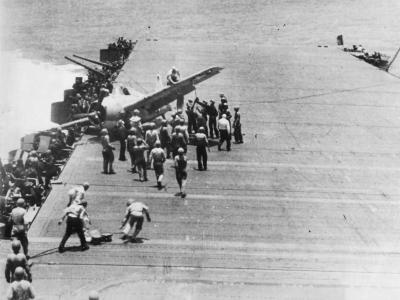
Grumman F4F Wildcat crash

Grumman F4F Wildcats of Joe Foss's Marine Squadron 121

Grumman F4F-4 Wildcats VF-11 lined op on Guadalcanal Airfield 1943

Grumman Martlet and Seafires on the flight deck of HMS Formidable November 1942 (color photo)
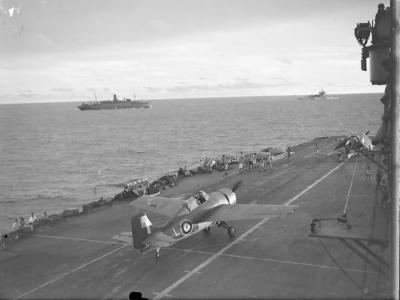
Grumman Martlet L of 888 Squadron FAA flight deck of HMS Formidable Madagascar May 1942

Grumman Martlet Mk II AJ132 from No 881 Squadron FAA McKinnon Road East Africa

Grumman Martlet Mk II D AJ128 of 888 Squadron FAA on board HMS Formidable

Grumman Martlet Mk II on the flight deck of HMS Formidable September 1942
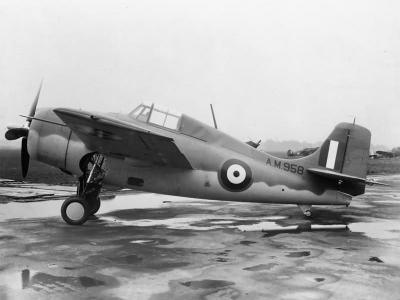
Grumman Martlet Mk III AM958 June 1941

Grumman Martlet Mk IV FN144 is warmed up on board HMS Formidable

Grumman Martlet on the flight deck of HMS Formidable November 1942 (color photo)

Grumman Martlet on the flight deck of HMS Formidable September 1942

Grumman Wildcat 'F' of No 846 Squadron FAA with D-Day stripes

Grumman Wildcat fighter of No 882 Squadron Fleet Air Arm being manoeuvred into position for takeoff from HMS PURSUER off the northern coast of Norway

Grumman Wildcat of No 881 Squadron FAA take off from HMS Illustrious Indian Ocean
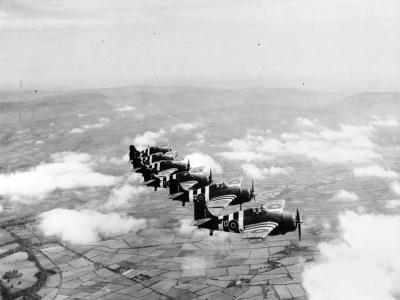
Grumman Wildcats of No 846 Squadron FAA with D-Day markings in flight.
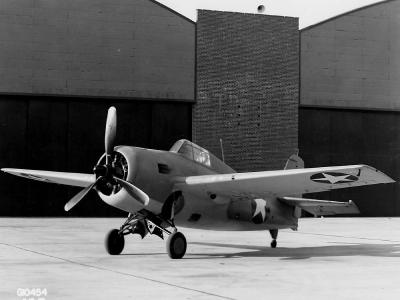
Grumman XF4F-8 Wildcat - prototype of the General Motors FM-1 Wildcat
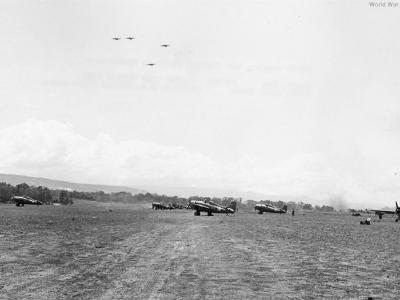
Marine F4Fs at cow pasture part of Fighter One airstrip at Lunga Point fall 1942

Marine Wildcat landing on Henderson Field 1942
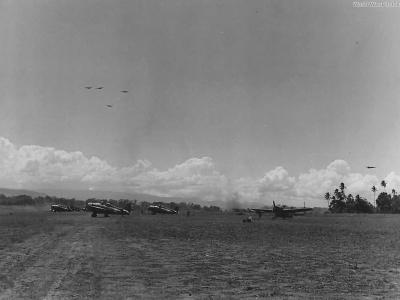
Marine Wildcats cow pasture part of Fighter One airstrip at Lunga Point, Guadalcanal fall 1942
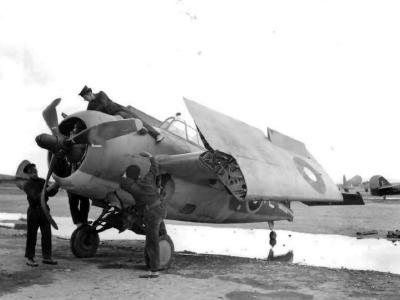
Martlet Mk III FAA North Africa 5 January 1943

Martlet of FAA trials aboard HMS Victorious September 1942

Martlet on coard HMS Formidable December 1942

Martlets Mk IV Fairey Barracudas and Seafires on the flight deck of the HMS Illustrious North Sea July 1943

Martlets on board HMS Formidable April 1943
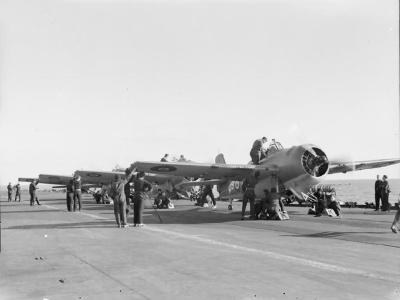
Martlets on the flight deck

Martlets on the flight deck of HMS Illustrious December 1942 Indian Ocean

Pilot by His damaged F4F Wildcat on Aircraft Carrier Deck

Pilot Crash Lands F4F Wildcat GS-4 on Guadalcanal
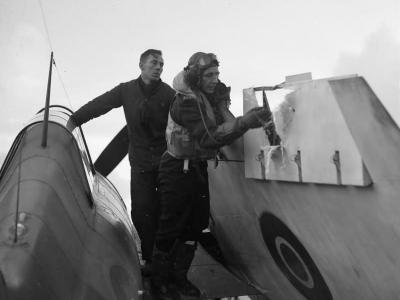
Pilot examining flak damage to aileron of his Wildcat December 1944

Pilots at NAS Sanford in front of an FM Wildcat, 10 September 1944
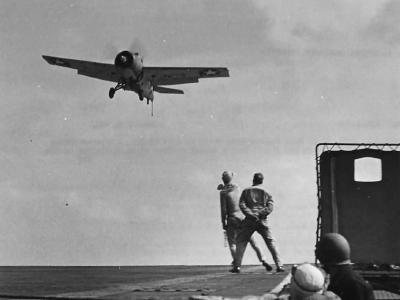
Signal Officer Directs Grumman Wildcat F4F Landing on Carrier 1942 Operation Torch
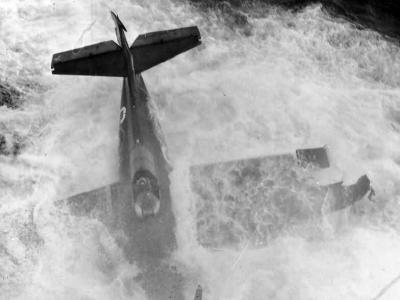
Sinking Martlet HMS Searcher
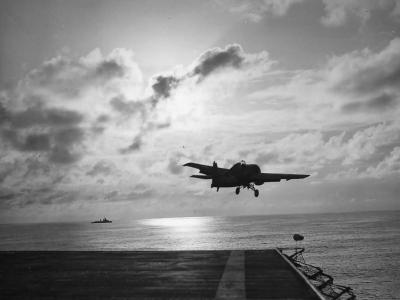
US Navy Grumman Wildcat F4F Takes Off from Carrier 1943
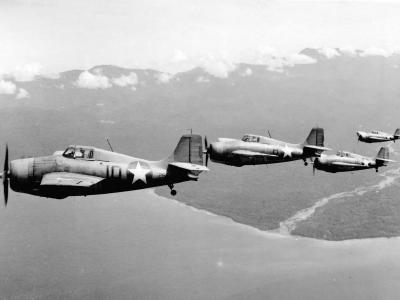
USMC Grumman F4F Wildcats over Guadalcanal 1943

VF-3 Ace Lt. Scott McCuskey and Ens. George Gay after Battle of Midway
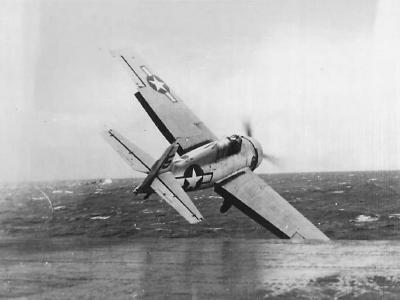
Wildcat ditched and pilot Lt Julius Brownstein will be rescued in North Atlantic 1943
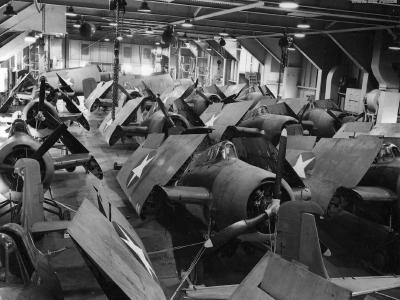
Wildcats packed on the hangar deck of the carrier USS Charger (ACV-30) 1942
Grumman F4F Wildcat - US Navy fighter of World War II. In the UK known as Martlet or Wildcat. Later versions produced by GM called General Motors FM Wildcat. The first plane of this type, designed as the successor also produced in plants Grumman F3F was to be just like his predecessor biplane. When, however, the US Navy ordered a prototype aircraft competition (jednopłatowy Brewster Buffalo XF2A-1), the company decided to change the concept of the plane on monoplane. The new prototype - XF4F-2, for the first time took off September 2, 1937. The airplane has a retractable front landing gear and 14-cylinder Pratt & Whitney R-1830-66 Twin Wasp (1050 hp) driving a three-bladed propeller with variable pitch. It was armed with two machine guns Browning cal. 7.62 mm in the motor housing and 2 MG 12.7 mm built one in each wing. During the tests, due overheating engine, the aircraft was seriously damaged during an emergency landing, which was one of the reasons why the order by the Navy competitive Brewster F2A Buffalo. Command of the Navy, it was not fully convinced of the plane Buffalo, therefore, decided to order the plants Grumman another prototype fighter, designated XF4F-3. Shattered prototype completely rebuilt and after many changes was an airplane named XF4F-3.
In XF4F-3 installed engine Pratt & Whitney XR-1830-76 Twin Wasp with (1217 hp) fitted with a two stage compressor also slightly changed the structure of the wings and fuselage. The performance of the new prototype had a good impression on the headquarters of the US Navy and in August 1939, it ordered 78 copies of the serial F4F-3. In 1941 a plane for the first time officially called the Wildcat.
Serial Wildcats were armed with four 12.7 mm machine guns (two in each wing). The later ones were added self-sealing fuel tanks and bullet-proof shield canopy. Used initially R-1830-76 engine was replaced after less unreliable R-1830-86. The airplane has two windows in the floor of the cockpit, which took improve downward visibility. Retractable front landing gear was operated manually by the pilot. US Navy bought a total of 285 aircraft F4F-3.
Due to problems with the engine, Pratt & Whitney R-1830-76, the management company Grumman decided to “just in case” to build two prototypes XF4F-5 with motor Wright Cyclone R-1820-40. Driven by similar premises US Navy ordered prototype XF4F-6 equipped with a Pratt & Whitney R-1830-90 Twin Wasp with a two-speed compressor. Despite less power at high altitudes, the US Navy ordered 95 fighters XF4F-6 marking them F4F-3A.
In March of 1940. Grumman received an order for installation in the recent serial F4F-3 folding wings, allowing load on an aircraft carrier more planes. As the wings folded up not fit into the hangars US aircraft developed an innovative method for submitting wings to the rear. New fighters, equipped with new wings, thicker armor, an additional 2 machine guns in the wings, and likely to transmit under each wing 220-liter additional fuel tank had designation F4F-4. US Navy received 1169 F4F-4. Due to the high demand for fighters, it was decided to start production at General Motors. There manufactured FM-1 were identical to F4F-4, but planes was arming wth 4 x 12,7 mm.
The last and produced the largest number of aircraft was a variant FM-2, built in 1943 on the basis of a prototype XF4F-8. From its predecessors, this model differed new engine (the Wright R-1820-56W). Increased engine power maintained the good performance of the airplane towards increasing due to the extra weight of the armor and installations. Manufactured 4407 fighters of this type for the US Navy. Last 1400 copies equipped with a stub pylons for 6 unguided rocket HVAR, allowing effectively attack ground targets and submarines. Some F4F-3 and F4F-4 adapted for reconnaissance missions - changing designations on F4F-3P and F4F-4P. Manufactured also 21 reconnaissance F4F-7 without weapons. In total factory left 8061 Wildcats, of which 450 passed the UK (reached 435). Production Wildcats ended in May 1945.
British Versions - Martlets: • Martlet Mk I (AL236-AL262, BJ507-BJ527, BJ554-BJ570, BT447-BT456) - 85 aircraft for France (81 delivered). After fall of France in 1940, transferred to the Royal Navy. They were F4F-3 fitted with engines Wright R-1820-G205 Cyclone (1000 hp). • Martlet Mk II (AM954-AM999, AJ100-AJ153)- 100 F4F-3 with an engine Pratt & Whitney S3C4-G Twin Wasp and folding wings. • Martlet Mk III (I) (AM954-AM963 ) - 10 machines identical to the Mark II, but did not have folding wings. • Martlet Mk III (II) (Bu No. 3875-3904, FAA: AX725-AX747,753,754,761,824-829,HK841-842) - 30 F4F-3A destined for Greece, but after the capitulation of Greece transferred to the FAA. • Martlet Mk IV (FN100-FN319) - 220 F4F-4 with an engine Wright Cyclone R-1820-40B. • Martlet (Wildcat) Mk V (JV325-JV636) - 312 identical machines with FM-1. • Wildcat Mark VI (JV637-JV924, JW785-JW836, JZ860-JZ889) - 370 FM-2.
General Specifications
- Type: Single-seat fighter.
Wings
- Configuration: Mid-wing cantilever monoplane with a NACA 23015 wing section.
- Structure: All-metal with a single aluminum-alloy spar, butt-jointed and flush-riveted smooth metal skin.
- Flaps: All-metal, vacuum-operated split trailing-edge flaps.
- Folding Mechanism: Yes, the wings can fold.
Fuselage
- Construction: Oval section monocoque structure made from aluminum-alloy.
Tail Unit
- Type: Cantilever monoplane type.
- Construction: Aluminum-alloy with metal-covered fin and tail-plane; fabric-covered rudder and elevators.
Landing Gear
- Type: Retractable main gear (Grumman type) with wheels retracting into the sides of the fuselage. The tail-wheel is fixed.
Power Plant
- Engine Options:
- FM-1 (Wildcat V): Pratt & Whitney R-1830-86 radial air-cooled engine.
- FM-2 (Wildcat VI): Wright R-1820-56 radial air-cooled engine.
- Propeller: Curtiss Electric or Hamilton-Standard Hydromatic constant-speed airscrew.
- Fuel Capacity: 160 U.S. gallons in self-sealing tanks in wings, with the option for droppable fuel tanks on wing bomb-racks.
Accommodation
- Cockpit: Enclosed with a sliding transparent canopy located over the center of the wing. The cockpit features a bullet-proof windshield and armor behind the pilot.
Armament and Equipment
- Guns: Six 0.50 cal. machine guns, three mounted in each wing.
- Bomb Capacity: Racks for two 250 lb. bombs, one under each wing.
- Reconnaissance Capability: Some versions equipped for long-range photographic reconnaissance, replacing armor and tank protection with camera equipment.
Dimensions
- Span: 38 ft. (11.6 m.)
- Width (folded): 14 ft. 6 in. (4.4 m.)
- Length: 28 ft. 10 in. (8.5 m.)
- Height: 11 ft. 11 in. (3.6 m.)
- Wing Area: 260 sq. ft. (24.2 sq. m.)
Performance (FM-1 Model)
- Normal Loaded Weight: 7,412 lbs. (3,365 kg.)
- Maximum Speed: 318 m.p.h. (509 km/h)
- Rate of Climb: 1,920 ft./min. (586 m/min)
- Service Ceiling: 34,800 ft. (10,615 m)
- Maximum Range: 925 miles (1,480 km)
Bibliography:
- Edward M. Young, Jim Laurier: F4F Wildcat vs A6M ZERO-SEN: Pacific Theater 1942, Osprey Duel 54
- S. Navy Carrier Fighters Of World War II: F2A Buffalo - F4F Wildcat - F6F Hellcat - F4U Corsair - F8F Bearcat - Aerodata International 6204, Squadron/Signal Publications 1987
- Mark Glidden: Modelling the F4F Wildcat, Osprey Modelling 39, 2007
- Richard S. Dann: F4F Wildcat in action, Squadron/Signal Publications, Aircraft Number 191, 2004
- Bert Kinzey: F4F Wildcat in Detail & Scale 65
- Andre R. Zbiegniewski, Krzysztof Janowicz: Grumman F4F Wildcat, Kagero Monographs 12
- Thomas McKelvey Cleaver, Jim Laurier: F4F Wildcat and F6F Hellcat Aces of VF-2, Osprey Aircraft of the Aces 125
- Richard Dann: F4F Wildcat, Walk Around Number 4, Squadron/Signal Publications 5504, 1995
- Glen Phillips: Grumman F4F Wildcat, Warpaint Series 9
- Barrett Tillman: Wildcat Aces of World War 2, Osprey Aircraft of the Aces 3
- Frank L. Greene: The Grumman F4F-3 Wildcat, Aircraft Profile Number 53
- Grumman F4F, F6F, F8F - Famous Airplanes of the World 35 (japanese)
- Pilot's Handbook of Flight Operating Instructions Navy Model FM-2 British Model Wildcat VI Airplanes
- Bert Kinzey: U.S. Navy and Marine Aircraft of World War II Part 2: Fighters, Revell-Monogram 2004
- Barrett Tillman:Wildcat: The F4F in WW II
- Shigeru Nohara, Tomoo Yamada:Grumman F4F Wildcat, Aero Detail 22 (japanese)
- Ray Merriam: World War II Album Volume 13: Grumman F4F Wildcat
- Rene J Francillon: Grumman Aircraft since 1929, Putnam 1989
- John M. Elliott: The Official Monogram U.S. Navy and Marine Corps Aircraft Color Guide, Vol 2: 1940-1949
- Thomas E. Doll: US Navy Aircraft Camouflage & Markings 1940-1945, Squadron/Signal Publications 6087