Early Hawker Tempest Mk V
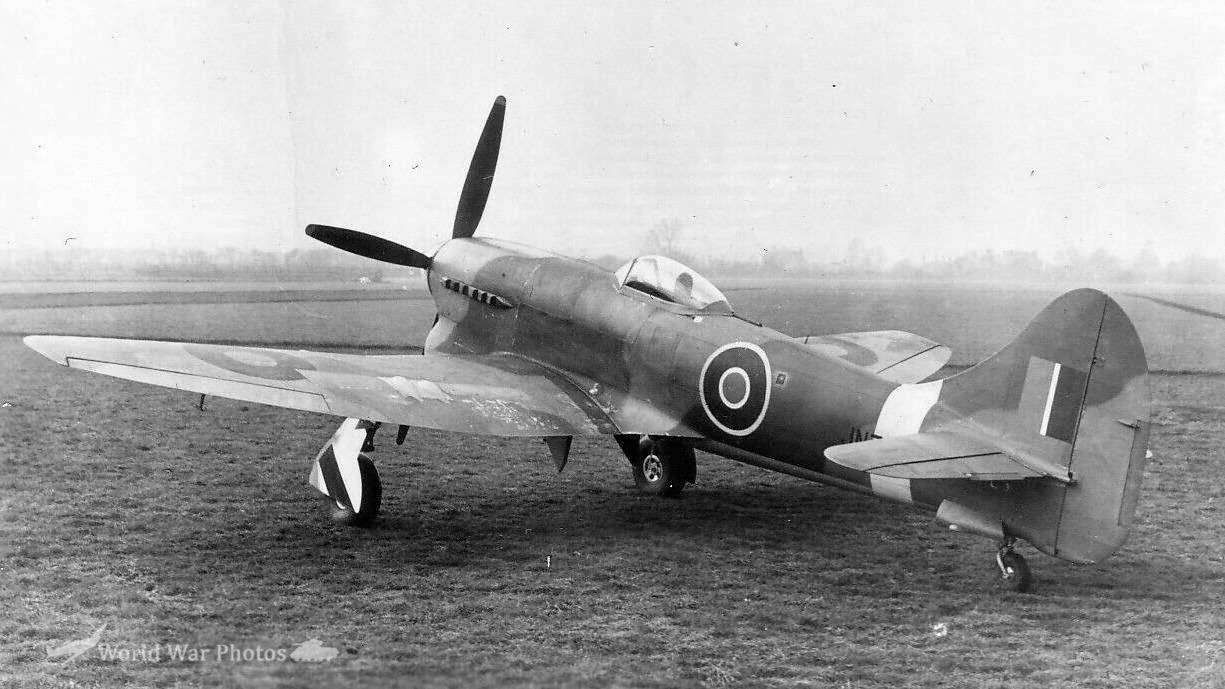
Tempest V
The Hawker Tempest Mk V emerged as a crucial variant, paradoxically entering service earlier than its numerical predecessors like the Mk I and Mk II, due to various development delays with other engine types. Its lineage can be traced back to the Typhoon II design, which was proposed in response to limitations identified in the Typhoon’s thick wing section, particularly severe buffeting and aileron reversal at speeds approaching 500 mph. The Mk V was fundamentally distinguished by its thinner, semi-elliptical wing section, which was five inches shallower at the root than the Typhoon’s wing, with a thickness/chord ratio reduced to 14.5% at the root and 10% at the tip. This design necessitated moving the engine forward by 21 inches to accommodate a new 76-gallon fuel tank in the fuselage, as the wing could no longer house the fuel. The Tempest Mk V was powered by a Napier Sabre IIA, IIB, or IIC engine, rated at 2,180 hp. The prototype, HM595, first flew on 2 September 1942. Initially, it featured a tail unit and cockpit enclosure similar to the Typhoon, but subsequent production aircraft incorporated a dorsal fin fairing and an increased-chord tailplane to compensate for the lengthened fuselage. Later Tempest Vs, along with the Mk VI, were fitted with patented Hawker spring tabs. The Tempest Mk V entered service in June 1943, with the first production aircraft flying on 21 June 1943. Fifty Mk Vs were delivered to Newchurch in Kent, where the first Tempest Wing, comprising No. 3 and No. 486 Squadrons, was formed under the command of Wg Cdr R.P. Beamont in April 1944. No. 56 Squadron joined them in June 1944. The Mk V played a pivotal role in combating the V1 flying bomb (code-named ‘Diver’) offensive on Southern England during the summer of 1944. Tempests were immediately switched to a defensive role against the V1s from 13 June to 5 September 1944, destroying 638 flying bombs out of the RAF’s total of 1,771. Tactics evolved to counter these small, fast targets, with cannon harmonization set to hit a point at 300 yards. Despite successes, the campaign was costly, with 31 Tempests written off and ten pilots lost during anti-‘Diver’ operations, at least 13 of which were due to engine failures. Problems included propeller oil seal failures and faulty constant speed units (CSUs), causing oil-obscured windscreens and forced landings. The high speed of the Tempest was critical, and efforts were made to improve it further, including stripping off the drag-inducing ‘D-Day stripes’ distemper and increasing engine boost with 150 octane fuel. After the V1 launch sites were overrun, Tempest Vs were extensively used in the ground attack role in continental Europe with the 2nd Tactical Air Force (2nd TAF) from September 1944. They performed “armed recces,” fighter sweeps, and escorts, primarily targeting enemy airfields, radar installations, and transport facilities. The Mk V proved highly effective against German aircraft, including the Fw 190 and Bf 109, and was notably successful against Messerschmitt Me 262 jet fighters, destroying at least eleven in the final six months of the war, a tally unmatched by other Allied fighters. However, operations were hazardous due to intense German flak, which caused more Tempest losses than aerial combat. Ground running and taxiing could also be problematic due to temperamental starting, oil smoke, and visibility issues from the long nose, necessitating wingtip guidance from groundcrew.